
Structure of the Framework
The framework is structured to outline the knowledge, skills and behaviours necessary for practitioners working within the service, spanning career levels 2 to 8 across four pillars of practice. Each level of practice is associated with specific knowledge and skills related to these pillars.
The framework encompasses several key components, including:
- Explanations of the pillars of practice and career levels.
- Guidelines for recording learning.
- Information on delegation, support, and supervision.
- Instructions on how to utilise the framework.
- Additionally, it provides role descriptors, details on educational preparation, and outlines the knowledge, skills, and behaviours required for each level of practice.
Pillars of practice
The framework focuses on the clinical pillar of practice however all pillars should be considered (figure 1).
These are:
- Clinical Practice: the knowledge, skills and behaviours needed to provide high quality healthcare that is safe, effective and person centred.
- Facilitating Learning: the knowledge, skills and behaviours needed to enable effective learning in the workplace.
- Leadership: the knowledge, skills and behaviours needed to lead and to fulfil management responsibilities.
- Evidence, Research and Development: the knowledge, skills and behaviours needed to use evidence to inform practice and improve services.
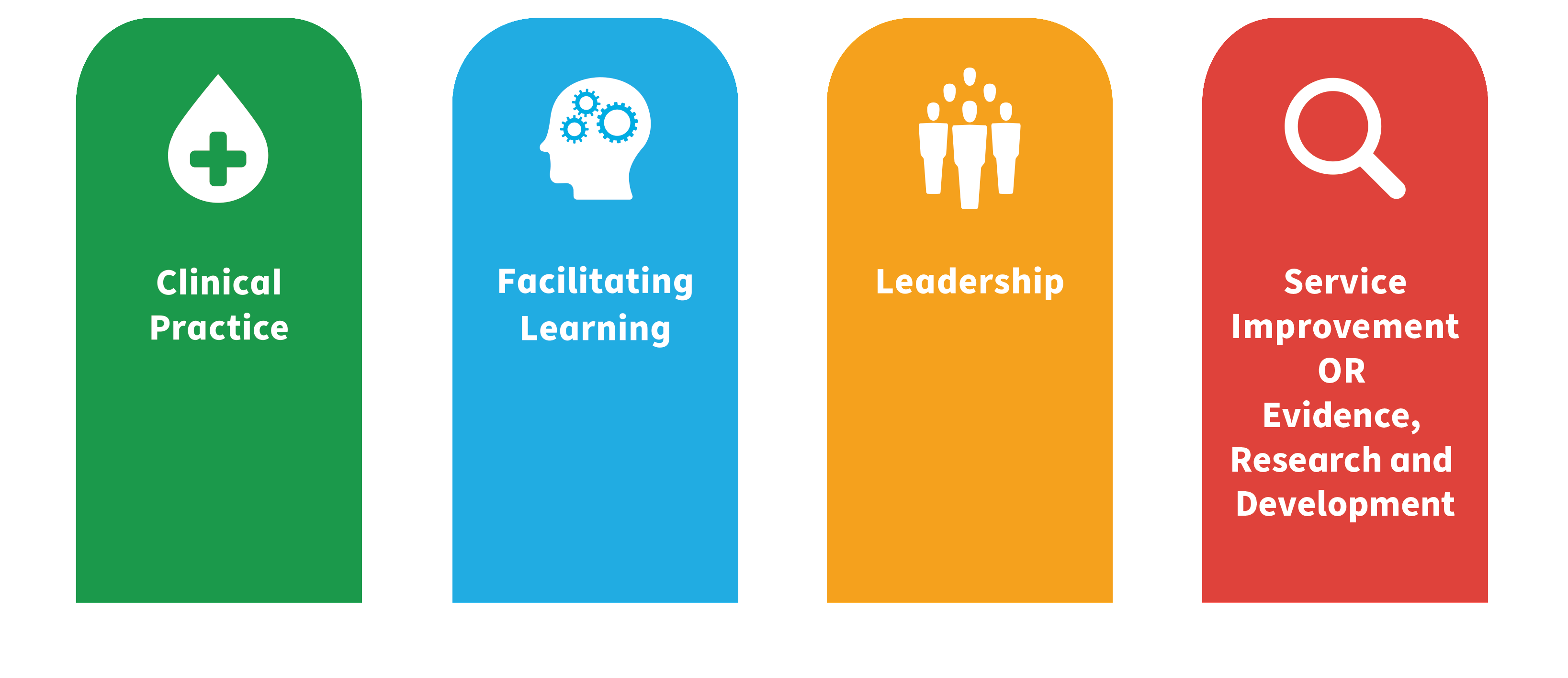
Figure 1: Pillars of Practice
Further explanation of the pillars of practice is available within the NMAHP development framework.
Levels of practice
The framework recognises how complex healthcare practitioner's roles have become and helps to explain the difference in expectations and learning at different levels. These levels are described in the Career Framework for Health which reflects role development and progression. These levels are not the same bands in Agenda for Change, which are related to remuneration. It also reflects the education and career development pathways model set out in the Transforming Roles programme.
These levels of practice are:
- Level 2 Healthcare Support Worker (HCSW)
- Level 3 Senior HCSW
- Level 4 Assistant Practitioner
- Level 5 Practitioner
- Level 6 Senior Practitioner
- Level 7 Advanced Practitioner
- Level 8 Consultant Practitioner
Further explanation of the levels of practice is available within the NMAHP development framework.
Levels of practice and pay bands
It is important to understand that the levels of practice outlined in the framework differ fundamentally from pay banding. The levels represent career progression and are not tied to the Agenda for Change (AfC) pay bands, which are determined by employers and relate to remuneration.
HCSWs typically operate within Levels 2 to 4 of the development framework, while Nursing, Midwifery, and Allied Health Professional (NMAHP) registrants generally fall within Levels 5 to 8.
A note regarding skin cancer
It is acknowledged that there are considerable differences in working practices within dermatology departments in Scotland. In some areas, skin cancer nursing is either a specialist role or a component of a multi-faceted role, whilst in other areas there are dermatology nursing roles that do not involve any skin cancer component. For this reason, there are separate competencies specifically for skin cancer nursing which can be adopted as required, depending on locally agreed job plans and associated scope of practice.
A note regarding surgery
Likewise, skin surgery is not a requirement of all level 6 and 7 dermatology posts and performing skin surgery alone does not determine the level of practice demonstrated by the practitioner. If performing skin surgery is part of a job description then Competencies 6C32 and 7C27, together with Appendices 4 and 5, should help to form the basis of local job plans.
Related frameworks
The structure of this framework builds upon the NMAHP Development Framework to demonstrate the knowledge, skills and behaviors required by practitioners for career progression and working in the service area.
The Framework for Specialist Nursing in Dermatology has been designed to align with Transforming Roles Paper 8. Competencies developed by the British Dermatology Nursing Group have been used extensively in the development of this document.
NHS Scotland’s Values
Throughout this framework, the core values shared across Scotland’s Health Service will be embedded. The core values include:
- care and compassion
- dignity and respect
- openness, honesty, and responsibility
- quality and teamwork
(Scottish Government, 2013)
Equality and health inequalities statement
We are firmly committed to improving population health, reducing health inequalities, and working nationally and locally with partners to make a positive and lasting impact to improving the wellbeing of the people of Scotland.
Promoting equality and addressing health inequalities are at the heart of delivering effective and high-quality care. Throughout the development of this framework, the three parts of the
Public Sector Equality Duty have been considered:
- eliminate discrimination, harassment, victimisation and any other conduct that is prohibited by or under the Equality Act 2010;
- advance equality of opportunity between persons who share a relevant protected characteristic and persons who do not share it; and
- foster good relations between persons who share a relevant protected characteristic and persons who do not share it.